If you want a gentle shortcut into Honolulu’s past, start at Aloha Tower. You’ll spot this 184-foot landmark on the downtown waterfront, where its carved “ALOHA,” old clock, and lookout room still watch the harbor. You can picture arriving by ship as horns echo and trade winds move through the open arches. It’s handsome, useful, and a little theatrical. But its biggest stories begin once you look past the postcard view.
Key Takeaways
- Aloha Tower is a 184-foot waterfront landmark in downtown Honolulu at Honolulu Harbor on Oahu.
- Completed in 1926, it originally served as a lighthouse and welcome beacon for arriving ships.
- Architect Arthur L. Reynolds designed it with Late Gothic Revival and Art Deco details.
- Its top lookout helped harbor pilots guide ship traffic, and it remains a symbol of Honolulu’s maritime history.
- Today, visitors can usually see it at Pier 9, though tower interior access may be limited.

Oahu Ka Moana Lūʻau at Aloha Tower Oceanfront Luau Show
Ka Moana Lūʻau – Oceanfront Hawaiian Luau in HonoluluExperience the spirit of Hawaiʻi at Ka Moana Lūʻau, a top-rated Honolulu luau set at his...
What Is Aloha Tower?
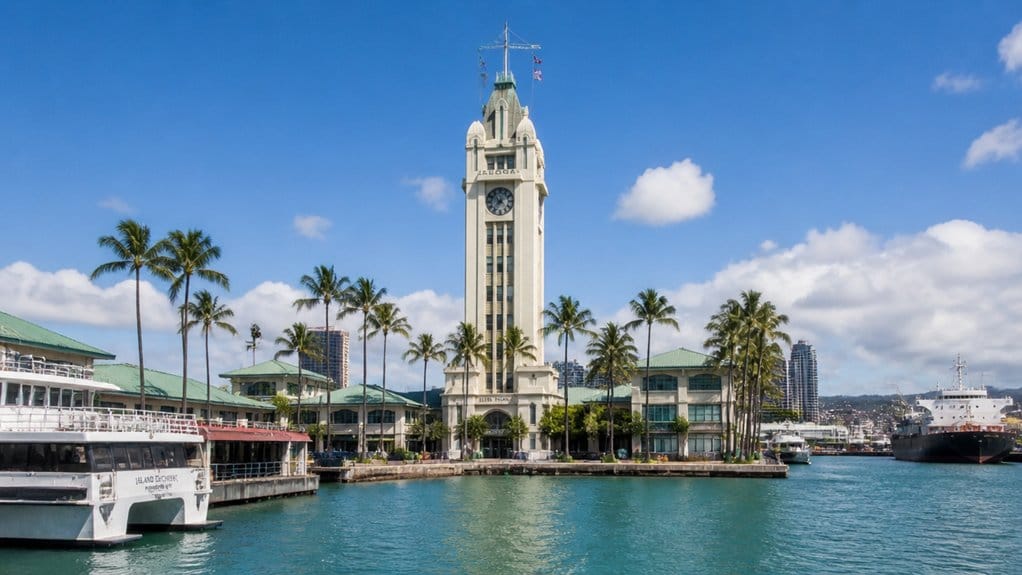
At Honolulu Harbor, Aloha Tower rises 184 feet above the waterfront as one of Oahu’s most recognizable historic landmarks. You see it first as a former lighthouse, completed in 1926, that welcomed arriving ships like a seaside beacon of aloha. Its giant weight driven clock and the word ALOHA carved into the walls give it real character.
You’re also looking at a key piece of Honolulu Harbor maritime history. Architect Arthur L. Reynolds mixed Late Gothic Revival and Art Deco details, so the tower feels both sturdy and stylish. On the top floor, harbor pilots once used the lookout to guide traffic below. Like Aloha Tower, Kapiʻolani Regional Park is another cherished Oʻahu historic landmark, dedicated by King Kalākaua in 1877 and still open free to the public today. Today, near Aloha Tower Marketplace, you can still sense salt air, hear harbor sounds, and imagine travelers spotting this landmark with relief, excitement, and probably better hats too. For more maritime history on Oahu, the Pacific Fleet Submarine Museum offers access to the WWII submarine USS Bowfin with free audio guides in seven languages.
If you are planning a downtown historic sightseeing day, Iolani Palace is generally open Tuesday through Saturday and makes an easy add-on not far from the harbor.
Where Is Aloha Tower in Honolulu?
You’ll find Aloha Tower in downtown Honolulu at 1 Aloha Tower Drive, right on Honolulu Harbor where ships once looked for its familiar silhouette. As you walk the waterfront near Pier 8, Pier 9, and the cruise ship area by Pier 10, you can feel the harbor breeze and hear the steady clink of rigging. It’s also a manageable stop for travelers planning transportation from HNL before or after time in Waikiki. Visitors using a shared round-trip transfer from Honolulu Airport can also reach the nearby hotel or cruise terminal area conveniently. As a quick reference, the Aloha Tower Drive address makes it easy to find this landmark fast in Honolulu. It’s an easy stop in the seaside district, so you can pair the tower with nearby downtown sights without playing hide and seek with your map.
Honolulu Harbor Setting
Harbor landmark and old-school welcome sign, Aloha Tower rises from Honolulu Harbor at Pier 9 on Oʻahu’s downtown waterfront, at 1 Aloha Tower Drive. When you approach the water, you spot the Tower beside the cruise ship terminal zone, near Pier 10 and not far from other working piers.
You’re standing in the middle of Honolulu Harbor history and motion. Built in 1926 as a lighthouse and greeting beacon, Aloha Tower still feels like a sailor’s hello. At 184 feet, it lifts above the waterfront with easy confidence. Around it, you’ll find the Aloha Tower complex and a spread of nearby piers, from 5 and 6 to 8 through 23. Visitors heading onward can compare shared or private shuttle options for the trip from Honolulu Airport to Waikiki. If you continue from here toward Oʻahu’s beach districts, it helps to remember swim safely whenever you enter the ocean. You can watch ships, hear harbor sounds, and get why this spot became Honolulu’s classic seaward welcome. It’s also one of the waterfront landmarks highlighted on the Waikiki Trolley Red Line route through historic Honolulu.

Oahu: Mauka Warriors Luau Honoring Polynesia's Forgotten History
Step into the vibrant heart of Hawai‘i and experience a luau like no other—where culture, history, and celebrati...

Toa Luau at Waimea Valley, Oahu
Toa Luau invites you to immerse yourself in the beauty and excitement of Polynesia on Oahu’s historic North Shore!...
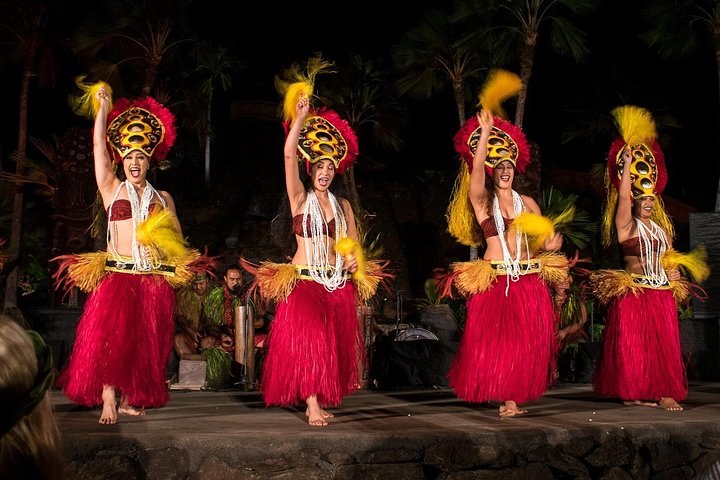
Oahu: Chief's Luau Admission
Attend a luau on Oahu produced by the Original World Fire Knife Dance Champion, Chief Sielu. During this 3 to 3.5-...
Downtown Honolulu Address
Finding Aloha Tower is easy once you’re near the downtown waterfront. You’ll find Aloha Tower in Downtown Honolulu on Oʻahu at 1 Aloha Tower Drive, Honolulu, HI 96813-4815. The harbor setting makes the address feel memorable. Water glints nearby, sea air moves through the streets, and the landmark rises above the district like a friendly guidepost.
If you’re plugging directions into a map, you may also see 155 Ala Moana Blvd, Honolulu, HI used as a mailing address. Both point you to the same waterfront area in the harbor district. Once you arrive, you’re right in the heart of Honolulu’s working shoreline, close to familiar harbor landmarks, restaurants, and downtown sights. It’s a practical location, and yes, far easier to find than some mysteriously numbered island addresses.
Nearby Pier Access
Right by the piers, Aloha Tower gives you one of the easiest waterfront landmarks to spot in Honolulu. You’ll find it at Pier 9 in Honolulu Harbor, just outside the cruise terminal zone near Piers 8 and 10. If you step off a ship, you can reach it without much guesswork.
From here, you get handy public access to the downtown harborfront walk. The tower links visually and historically with nearby piers, including stretches around Piers 5 and 6 and farther along Piers 8 through 23. If you’re planning more of Oahu after downtown Honolulu, Pearl Harbor is also on Oahu, making it a practical same-island stop for many visitors. Visitors also often pair downtown sightseeing with mid-range Oahu tours that keep activities under $150. Aloha Tower was placed where harbor activity stays front and center, so you can hear gulls, engines, and clinking rigging as you walk. Think of it as your Old royal pier compass, minus the velvet ropes. It’s practical, scenic, and pleasantly easy to navigate too.
Can You Visit Aloha Tower Now?
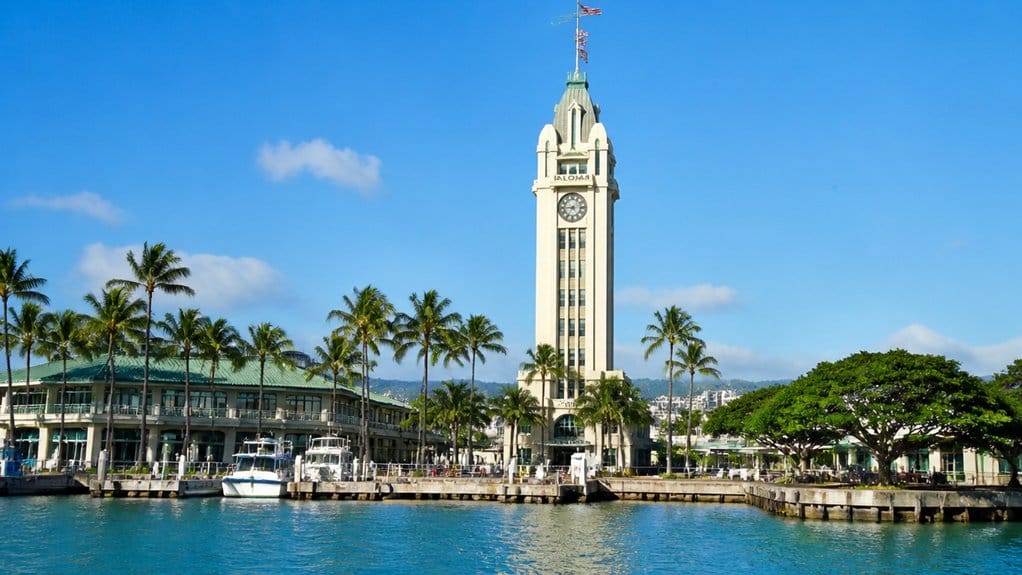
You can still visit Aloha Tower at Pier 9 in Honolulu Harbor, but your experience depends on whether the tower itself is open when you arrive. Recent reports say access to the tower has sometimes been limited by closures or renovation, even while the waterfront and nearby spots at the base stay lively with harbor views, meals, and a salty breeze. Before you go, check the posted 9:00 AM to 5:00 PM hours on the official site or call (808) 544-1453 so you don’t end up admiring the front door. If you’re pairing your day with Pearl Harbor, remember the Visitor Center there is open daily from 7:00 am to 5:00 pm. The USS Arizona Memorial program is free, though Recreation.gov fee of $1 per ticket still applies for reservations. The area is also known for the oceanfront luau experience at Aloha Tower, which adds another reason visitors stop by the harbor.
Current Access Status
Usually, Aloha Tower still makes a worthwhile stop, but tower access itself can be hit or miss right now. If you’re hoping to go up, don’t assume the doors will be open just because you’re standing at 1 Aloha Tower Drive near Pier 9. Recent visitor reports from 2024 through 2026 say the tower sometimes closes or undergoes renovation.
You’ll often see general hours listed as 9:00 AM to 5:00 PM daily, but upkeep or events can change that quickly. Before you head out, check alohatower.com or call (808) 544-1453 for the latest public access update. That extra step can save you a shrug and a long elevator stare. Like the entry flow at major historic sites, access procedures can shift day by day depending on operations. Nearby attractions on Oahu, such as the Waikīkī Aquarium, also post daily visitor hours that can change with facility operations. Even when tower entry pauses, the site still carries history, including its link to the attack on Pearl Harbor, and harbor breezes nearby. Visitors interested in Honolulu’s wartime history often pair this stop with a Pearl Harbor tour to add broader context to what they see around the harbor.
Still comparing Aloha Tower?
Ask for tour ideas, hotel suggestions, or a simple trip plan that combines both.
Trip Helper
Public Areas Available
So what can you actually visit at Aloha Tower right now? You can usually approach the waterfront area around the historic landmark at Pier 9 in Honolulu Harbor, but the tower interior and observatory may be closed or under renovation. Hours are posted as 9AM to 5PM, yet access can shift without warning. Nearby, Kewalo Basin Park closes from 10:00 p.m. to 4:00 a.m., with its comfort station and parking lots closed from 10:00 p.m. to 5:00 a.m.
- You can admire the tower from outside and feel that old Hawaii port energy.
- You might stroll parts of Aloha Tower Marketplace at the base, though university use limits some spaces.
- You can listen to harbor sounds, watch boats move, and catch salty breezes.
- You should check alohatower.com or call (808) 544-1453 before you go.
Unlike some Honolulu nightclubs, this stop is more about atmosphere and harbor history than paying a cover to get inside. Parking can be one of the trickier parts of a harbor-area visit, so it’s smart to review a parking guide before heading out.
If doors are shut, don’t worry. It’s still a striking waterfront sight, and the view rewards the detour.
What Is at Aloha Tower Today?
Although Aloha Tower no longer works as a full marketplace in the old sense, it still gives downtown Honolulu a memorable waterfront stop. You’ll find the 184-foot tower at Pier 9, rising over Honolulu Harbor as a landmark in Honolulu with broad views of ships, streets, and blue water.
Today, much of the complex belongs to Hawaii Pacific University, so some areas can feel quiet or even closed off. Still, you can browse a Barnes & Noble University Bookstore or grab a meal at Old Spaghetti Factory. Around the waterfront, you’ll also spot links to maritime life, including the former Hawaii Maritime Center site. Cruise terminals at nearby piers and local trolley service make the area easy to reach. If you like practical stops with a harbor breeze, this one delivers nicely.
Why Aloha Tower Matters in Hawaii History
Seeing Aloha Tower today is one thing, but knowing why it matters gives the whole waterfront more weight. Since 1926, this Hawaiian maritime landmark has stood over Honolulu Harbor as a welcoming beacon and a symbol of change. Its story also fits into Honolulu Hawaii history, reflecting the city’s shift from island roots to modern urban life.
Since 1926, Aloha Tower has given Honolulu Harbor a welcoming face and Hawaii a lasting symbol of change.
- You can picture the years when visitors arrived by sea and the tower marked Hawaii’s front door.
- You notice its 184-foot profile, where Late Gothic Revival meets Art Deco with surprising confidence.
- You feel the wartime tension too, when the Navy controlled it after Dec. 7, 1941, dimmed the beacon, and used camouflage.
- You appreciate why preservation counts, since it joined the National Register in 1976.
When you stand nearby, you’re not just seeing a tower. You’re looking at a place that watched Hawaii move from steamships to airplanes, almost without blinking. Hawaii also preserves places tied to Dec. 7, 1941, including the USS Arizona Memorial at Pearl Harbor National Memorial. Like other major Oʻahu landmarks managed for public appreciation, places such as Diamond Head are treated as significant resources for their natural, cultural, historical, and recreational value.

Waikiki Luau Buffet with Optional Rock-A-Hula Show Ticket
Join us for a “Hawaiian night” with an upscale all you can eat buffet and Luau-themed dinner in the heart of Wai...

Paina Waikiki Luau at Waikiki Beach Marriott
Everything that makes renowned Waikiki, Oahu, a unique and exciting place is celebrated at Pāʻina Waikīkī!A u...

Oahu: Germaine's Luau
Come visit us at Germaine's Luau, where you will experience a traditional Hawaiian Luau on our beachfront property o...
How Aloha Tower Greeted Ships
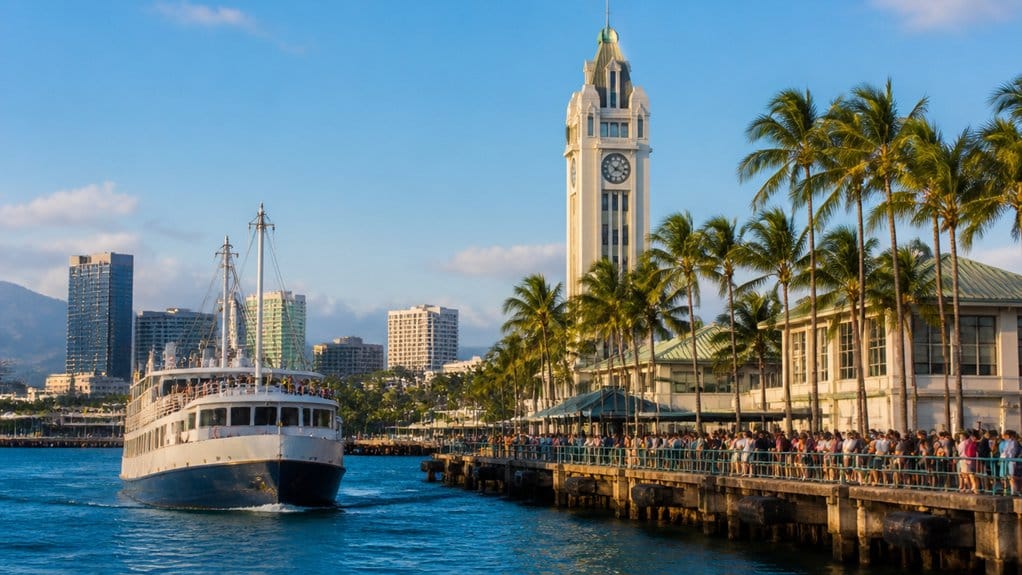
When ships approached Honolulu Harbor, Aloha Tower did exactly what it was built to do. From Pier 9, you could spot it long before land felt close. Standing tall at 184 feet, it worked like a seaside beacon of aloha, visible about 15 miles out.
As you sailed nearer, the etched ALOHA on its walls sent a literal welcome. The observatory and lookout station on the top floor also helped harbor pilots guide vessels safely into port. Before air travel reshaped arrivals, Boat Days turned the harbor into a lively community gathering. You’d hear cheers, horns, and chatter as steamships pulled in and families waited along the waterfront. For many passengers, the tower wasn’t just a building. It was Honolulu’s first hello, with better timing than any hotel concierge could manage. Today, travelers comparing ways to explore the island often weigh an Oahu attraction pass against a guided tour to decide what saves more.
What Happened to Aloha Tower in World War II?
After Pearl Harbor was attacked on December 7, 1941, Aloha Tower stopped acting like Honolulu’s cheerful greeter and shifted into defense mode. If you stood near Aloha Tower Honolulu then, you’d feel the mood change fast. Coast Guardsmen issued orders to keep the landmark from being occupied, and the United States Navy took control. Public access tightened, the beacon went dark, and camouflage paint dulled its familiar face. Tower was the tallest landmark, so hiding it mattered. Travelers exploring Honolulu’s wartime story often pair this history with USS Arizona Memorial tours from Waikiki for a fuller picture of Oahu’s harbor defenses.
- You’d miss the welcoming light.
- You’d notice soldiers and strict limits.
- You’d see paint swallowing bright details.
- You’d sense fear under the harbor breeze.
Naval forces, including the USCGC *Taney*, positioned nearby as protection. In 1947, civilian control returned, and workers sandblasted off the wartime camouflage, revealing the tower again. Many visitors connect this story with a broader Pearl Harbor tour that also highlights Honolulu’s World War II landmarks. Visitors planning a broader harbor history trip often learn that Pearl Harbor tickets include free options, though the most popular experiences can sell out.
Frequently Asked Questions
How Tall Is Aloha Tower Compared With Modern Honolulu Buildings?
You’ll find Aloha Tower stands 184 feet tall, so modern Honolulu buildings easily surpass it. In Historic comparisons, its height measurements place it below the modern skyline, though you still notice its landmark presence.
What Architectural Styles Influenced Aloha Tower’s Design?
You’d think architects hate subtlety: Aloha Tower draws chiefly from Late Gothic Revival and Art Deco. You can also spot Capitol inspired modernism, mid century functionalism, and harborfront vernacular cues shaping its confident profile.
Who Designed and Funded Aloha Tower’s Original Construction?
You can credit architect Arthur L. Reynolds with designing Aloha Tower’s original construction, but you can’t identify specific funders from the provided information. Skyline comparisons, Honolulu landmarks, and Design symbolism highlight its 1926 $160,000 significance.
Is Aloha Tower Listed on Any Historic Preservation Registers?
Yes, you can confirm Aloha Tower’s listed on the National Register of Historic Places since 1976. If you’re exploring T Mobile history, tower ownership changes, or surrounding park use, you’ll still find its preservation status well documented.
What Events or Ceremonies Are Held at Aloha Tower Today?
You’ll mostly find campus events, harbor gatherings, photo meetups, and occasional Hawaiian blessings at Aloha Tower today. You can also catch cruise-related welcomes and modern celebrations that highlight Honolulu’s waterfront cultural heritage, depending on access.
Conclusion
So when you stand by Aloha Tower, you’re not just spotting a postcard landmark. You’re meeting Honolulu’s old harbor sentinel, still watching the water like something out of The Odyssey. You can see the carved ALOHA, hear harbor sounds bounce off the pier, and feel the salt in the air. It’s easy to reach in downtown Honolulu, and still worth your time. A quick visit gives you history, views, and a strong sense of welcome.
Oahu Ka Moana Lūʻau at Aloha Tower Oceanfront Luau Show
Ka Moana Lūʻau – Oceanfront Hawaiian Luau in HonoluluExperience the spirit of Hawaiʻi at Ka Moana Lūʻau, a top-rated Honolulu luau set at his...