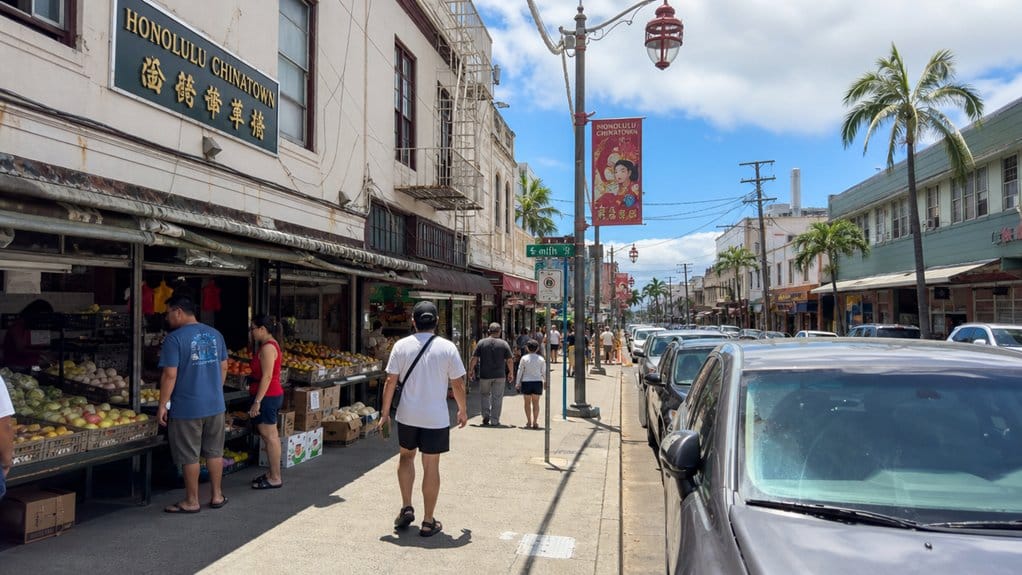
Like a bright seam stitched between downtown towers and the harbor, Chinatown Oʻahu sits on the western edge of Downtown Honolulu near North Hotel and Maunakea Streets. You’ll find its heart around Maunakea Marketplace, Oahu Market on North King Street, and the red paifang gates by Chinatown Cultural Plaza. It’s an easy trip from Waikīkī by car or bus, and even walkable if you’ve got sturdy shoes. But the real question isn’t just where it is.
Key Takeaways
- Chinatown Oʻahu is in downtown Honolulu, on the island of Oʻahu, just west of the main downtown core.
- Its commercial heart is around North Hotel Street and Maunakea Street, one of the neighborhood’s busiest intersections.
- The district stretches roughly from Beretania Street south toward Merchant Street and west toward Honolulu Harbor.
- It is about 3 to 4 miles west of central Waikīkī, around a 15-minute drive.
- Look for landmarks like Oʻahu Market, Chinatown Cultural Plaza, paifang gateways, and red bilingual street signs.

Oahu Ka Moana Lūʻau at Aloha Tower Oceanfront Luau Show
Ka Moana Lūʻau – Oceanfront Hawaiian Luau in HonoluluExperience the spirit of Hawaiʻi at Ka Moana Lūʻau, a top-rated Honolulu luau set at his...

Polynesian Canoe Sunset Sail
Kamoauli is a locally owned, all-wood, double-hulled, traditional sailing vessel (wa’a kaulua) offering a one-of-a...

Polynesian Canoe Day Sail
Kamoauli is a locally owned, all-wood, double-hulled, traditional Polynesian canoe (wa’a kaulua) offering a one-of...

Oahu: Mauka Warriors Luau Honoring Polynesia's Forgotten History
Step into the vibrant heart of Hawai‘i and experience a luau like no other—where culture, history, and celebrati...
Where Is Chinatown Oahu?
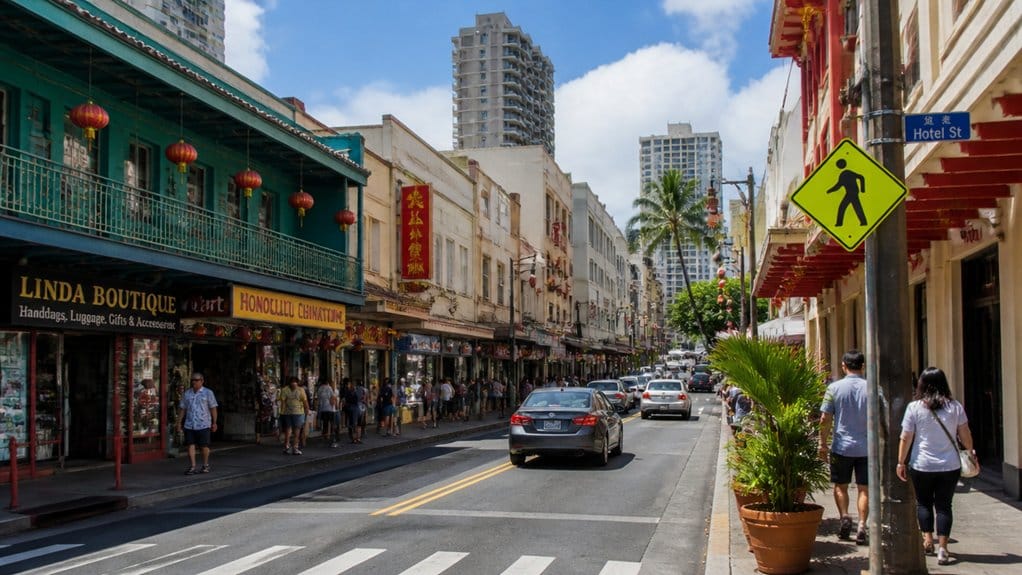
On the western edge of Downtown Honolulu, Chinatown sits around North Hotel Street and Maunakea Street, about 15 minutes west of Waikīkī. You’ll find Chinatown centered near that busy crossroads, then stretching north toward Honolulu Harbor by North Beretania and Nuʻuanu Streets. It also runs south along Merchant Street into the Chinatown Special District.
As you wander, look for red-framed bilingual street signs and two paifang archways near North King Street. Oahu Market, Chinatown Cultural Plaza, and Maunakea Marketplace help anchor the neighborhood, giving you easy reference points as you explore. The district covers about 522 acres, so it feels substantial without being overwhelming. You’re also close to the Hawaii Theatre on Bethel Street, plus Foster Botanical Garden and Iolani Palace if you keep walking. Not bad for one compact adventure zone. Chinatown is also a popular place to start an evening, with cocktail spots and bars adding nightlife energy around the neighborhood.
How Far Is Chinatown From Waikiki?
Getting from Waikīkī to Chinatown is easier than it looks. You’re heading about 3 to 4 miles west, so a normal drive takes around 15 minutes. If you use TheBus or a trolley plus a short walk, plan on 20 to 35 minutes. Walking sounds noble, but 1 to 1.5 hours in the heat can feel very long fast. Once you arrive, Honolulu Chinatown is known for its mix of food spots, bars, and night market energy.
| Route | Time | Scene |
|---|---|---|
| Drive | 15 min | Towers fade into markets |
| Bus | 20 to 35 min | Windows frame Downtown Honolulu |
| Walk | 1 to 1.5 hrs | Sun, sidewalks, steady traffic |
| From central Waikīkī | 3 to 4 miles | City blocks stack up |
| Near Chinatown | 0.6 to 0.8 miles | Downtown Honolulu landmarks appear nearby |
Which Streets Define Chinatown?
You can trace Chinatown’s edges from Beretania Street on the east to Honolulu Harbor on the west, with Nuʻuanu Avenue and nearby Nuʻuanu Stream helping mark the southern and northern bounds. Once you’re inside, North Hotel Street, Maunakea Street, and North King Street lead you through the busy commercial core, where markets, shop signs, and sidewalk chatter keep the blocks humming. You’ll also spot the district stretching along Merchant Street and into parts of Bethel, King, and Nuʻuanu, so it’s easier to get your bearings before you start wandering. For a smoother trip, use a Chinatown Honolulu visit plan to map your route before exploring the district.
Main Boundary Streets
For a quick mental map, think of Honolulu’s Chinatown as a compact grid that starts around Beretania Street on the east and stretches west toward the Honolulu Harbor waterfront.
From there, you can picture the north side near Nuʻuanu Stream, around Nuʻuanu Street and Nuʻuanu Avenue, where the streets feel older and a bit tighter. The south edge sits near Nuʻuanu Avenue and Merchant Street, and the Special District dips about a block and a half farther down Merchant Street. If you like visual clues, watch for the red-framed bilingual street signs. They make the area feel easy to read even when the layout gets slightly twisty. North Hotel Street and Maunakea Street also help you stay oriented, while the harbor side reminds you you’re never far from Honolulu Harbor and its salty breeze nearby. Once you have the boundaries in mind, it is easier to plan Chinatown activities around this compact, walkable district.

Toa Luau at Waimea Valley, Oahu
Toa Luau invites you to immerse yourself in the beauty and excitement of Polynesia on Oahu’s historic North Shore!...

Waikiki Luau Buffet with Optional Rock-A-Hula Show Ticket
Join us for a “Hawaiian night” with an upscale all you can eat buffet and Luau-themed dinner in the heart of Wai...

Oahu: Germaine's Luau
Come visit us at Germaine's Luau, where you will experience a traditional Hawaiian Luau on our beachfront property o...
Core Commercial Blocks
Start in the thick of it on North Hotel Street and Maunakea Street, where Chinatown’s commercial heart feels busiest and easiest to recognize. From here, you can trace the liveliest blocks toward Nuuanu Avenue, Bethel, and North Beretania. Red-framed bilingual signs, shop awnings, and old storefronts help you know you’re in the core.
- Walk Maunakea for Maunakea Marketplace, food stalls, and constant sidewalk energy.
- Follow North Hotel Street between Bethel and Nuuanu for lei sellers and guardian lions.
- Cut to North King Street to find Oahu Market and its no-nonsense produce bustle.
- Use Chinatown Cultural Plaza at 100 N Beretania as an easy landmark.
You’ll notice the district stretches wider, but these blocks feel like the center of gravity. Even your snack choices multiply fast. For a short visit, this core also works well as the starting point for a half-day stroll through Chinatown Honolulu.
Why Chinatown Oahu Matters
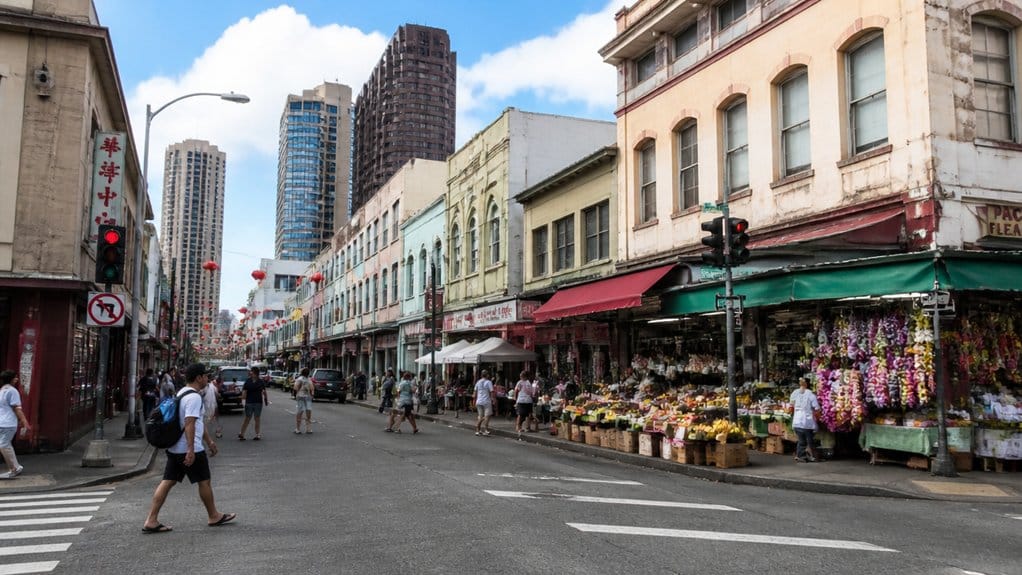
When you walk through Chinatown Oahu, you’re stepping into one of the oldest Chinese American communities in the country, where temple bells, bilingual signs, and sturdy brick buildings still carry Honolulu’s past. You can taste its living culture at Oahu Market and Maunakea Marketplace, where seafood, herbs, tropical fruit, and lei stalls keep the streets busy and fragrant. You’ll also find that Chinatown fuels the city’s creative pulse, with art walks and the Hawaii Theatre giving this historic district fresh energy after dark. It’s also a favorite stop for Honolulu noodles, bakeries, and late-night bites that show how much of the neighborhood’s story is told through food.
Historic Cultural Legacy
Because Honolulu’s Chinatown grew with the first wave of Chinese arrivals in the mid-1800s, it still feels like a living record of how Oahu changed. When you walk these blocks, you see why the Chinatown Special Historic District matters. Brick buildings from the 1901 rebuilding still anchor the streets.
- You can trace immigrant ambition in old shopfronts and trading spaces.
- Oahu Market shows how commerce helped workers become business owners.
- Kuan Yin Temple reveals spiritual roots that still shape daily life.
- Paifang gateways, lion statues, and walking tours make history easy to spot.
Its mix of Chinatown classics and modern Chinese favorites also shows how Honolulu’s food scene keeps the neighborhood’s heritage active and evolving.
You’re not just passing through a neighborhood. You’re stepping into one of America’s oldest Chinese communities, where preservation keeps memory visible, practical, and alive. Even the streets seem to whisper if you slow down and listen.
Arts And Food Hub
Often, Chinatown shows you why it still matters the moment you turn onto Maunakea or North Hotel Street. Here, you step into Oahu’s liveliest mix of arts and food. At Oahu Market and Maunakea Marketplace, weekend mornings from 8 to 12 bring seafood, tropical produce, lei makers, and even noodle demos. You can snack on dim sum, browse herbal shops, or book dinner at The Pig and the Lady.
After dark, the neighborhood shifts but never slows. Hawaii Theatre anchors the Arts District, while First Friday pulls you along Nuʻuanu and Bethel with gallery openings, live music, street performers, and food trucks. Weathered lofts hide galleries, bars, and clubs. You don’t just visit Chinatown. You taste it, hear it, and watch its creative pulse keep downtown Honolulu awake at night. Nearby Kakaako adds another creative stop with street art and coffee before a sunset walk.
Have a question about this guide?
Ask for tour ideas, hotel suggestions, or a simple trip plan that combines both.
Trip Helper
How to Get to Chinatown Oahu
Head west from Waikīkī and you’ll reach Chinatown on the edge of Downtown Honolulu in about 15 minutes, near North Hotel Street and Maunakea Street. Once you arrive, orient yourself by Nu’uanu Avenue and the busy market blocks. Chinatown feels most welcoming by day, when produce crates clatter and steam rises from food stalls.
- Ride TheBus into downtown for a simple, low-stress trip.
- Hop on the Waikīkī Trolley if you want an easy visitor-friendly route.
- Join the Tuesday walking tour from 8 South King Street for local context.
- Time your visit for Saturday morning near Oahu Market and Maunakea Marketplace.
For a fuller day in the area, pair your Chinatown visit with nearby Downtown Honolulu sights, food spots, and easy walks. You can also use Chinatown Cultural Plaza as a handy landmark while exploring. Stick to main commercial streets, keep your visit in daylight, and wander with curiosity.
Where to Park in Chinatown
You’ll have the easiest time at the Chinatown Cultural Plaza garage at 100 N. Beretania St, right by the market and arts district where the day starts with fruit crates, sidewalk chatter, and gallery doors swinging open. If you’re aiming for metered street parking on Hotel or Maunakea, go on a weekday afternoon if you can, because weekend mornings fill fast and those meters won’t cut you any slack. Check every posted sign before you walk away, and if spots disappear, you can always hop on TheBus, catch the Waikiki Trolley, or try nearby hotel parking. If you’re pairing Chinatown with a civic stop, review State Capitol parking and entry details before heading toward downtown Honolulu.
Best Parking Options
Usually, the simplest place to park in Chinatown is the Chinatown Cultural Plaza garage at 100 N Beretania St, since it puts you right by the main market blocks and saves you from circling busy streets.
- Use the Chinatown Cultural Plaza parking garage when you want the fastest access to shops, produce stalls, and dim sum stops.
- If you’re aiming for Oahu Market, arrive around 8 to 9 a.m. for nearby spaces, or park in the garage and walk over.
- Along Hotel Street and Maunakea Street, spots disappear fast on market mornings and First Friday, so plan ahead.
- For longer visits, choose off-street parking near downtown hotels like Aston at the Executive Centre and stroll 5 to 15 minutes in.
If your Honolulu plans also include the International Market, check parking and timing separately since it is outside Chinatown.
Bring change or mobile pay, and always read posted signs carefully.
Street Meter Tips
Often, street meters in Chinatown work best when you’re popping in for a quick market run or a short dim sum stop. You’ll find metered street parking along Hotel Street and Maunakea Street, where the signs and pay stations matter because enforcement is common and tickets aren’t charming souvenirs. Bring change or use a local pay by phone option, then double check posted hours since some stalls shut down or become restricted after business hours.
Weekend mornings fill fast, especially Saturday from 8 a.m. to noon during Oahu Market, when sidewalks buzz and parking spots vanish early. If you don’t score a curb space, head to Chinatown Cultural Plaza at 100 N Beretania St for easier access. Or skip parking entirely and ride TheBus or the Waikiki Trolley nearby instead. If your day includes sightseeing beyond downtown, Ko Olina Golf Club is another Oahu stop worth noting for its resort-side charm.
Oahu: Chief's Luau Admission
Attend a luau on Oahu produced by the Original World Fire Knife Dance Champion, Chief Sielu. During this 3 to 3.5-...

Pearl Harbor, Dole, and Polynesian Cultural Center from Waikiki
Join us on an unforgettable day at three of Oahu’s most popular attractions: Pearl Harbor, Dole Plantation, and Po...

Pearl Harbor USS Arizona Memorial
Turn back time as we explore WWII history at Pearl Harbor and relive the infamous Sunday morning of December 7, 1941...
Best Starting Point for Chinatown Oahu
Kick things off at Chinatown Cultural Plaza, 100 N. Beretania St. You’ll be on Chinatown’s western edge, close to Hotel and Maunakea, with easy garage parking and quick walking access. It’s the simplest launchpad if you want your bearings before diving in. Stroll toward Hawaii Theatre and let the street sounds, signs, and old brick buildings set the mood.
- Start at Chinatown Cultural Plaza for the easiest parking and orientation.
- Head to Maunakea Marketplace if you want to follow Maunakea Street on foot.
- Join the Chinese Chamber of Commerce Hawaii tour from 8 S. King St for rich context.
- Use Hotel or Maunakea metered spots if the garage’s full, then walk a few blocks.
Nearby downtown and Chinatown streets also put you close to some of the top restaurants Honolulu is known for.
You’ll save time, skip circling, and begin with confidence instead of guesswork.
Which Markets Are Worth Visiting?
For the fullest Chinatown market feel, make Oahu Market at 145 N King St your main stop, then wander over to Maunakea Marketplace at 1120 Maunakea St. You’ll catch stacked produce, fresh seafood, and strange-looking tropical fruit that begs for a photo. Go Saturday between 8 and noon if you want the fullest stalls and the most energy.
At Maunakea Marketplace, you’ll pass the brick arch, hear stall chatter, and find hot snacks, lei makers, Chinese greens, and herbal goods. Nearby shops along Maunakea carry specialty ingredients, teas, and even thousand-year eggs for brave shoppers. If you like people-watching, head to the River Street Pedestrian Mall in the morning or at lunch. It’s lively, easy to browse, and much quieter by late afternoon for most visitors.
Which Temples and Landmarks Should You See?
If you want Chinatown’s story in one easy walk, start with the Kuan Yin Temple and the Izumo Taishakyo Mission Shrine. You’ll see carved details, statuary, and quiet courtyards that reveal Chinese and Japanese roots still shaping the district today.
- Visit Kuan Yin Temple for traditional architecture and a calm pause.
- Step into Izumo Taishakyo Mission to spot a historic Shinto presence.
- Find the Sun Yat-sen Memorial at Chinatown Gateway Park near Hotel and Bethel Streets.
- Photograph the Wo Fat Building and the guardian lions on Hotel Street.
Keep walking and you’ll notice brick-and-masonry buildings from the 1901 rebuilding era. Pass through Chinatown Cultural Plaza, then look for old market textures, seafood counters, and herb scents nearby. It’s history with good lighting and better people-watching too. After sightseeing, consider a late stop at House of Wong Chinatown for late-night Cantonese favorites.
What’s Near Chinatown Oahu?
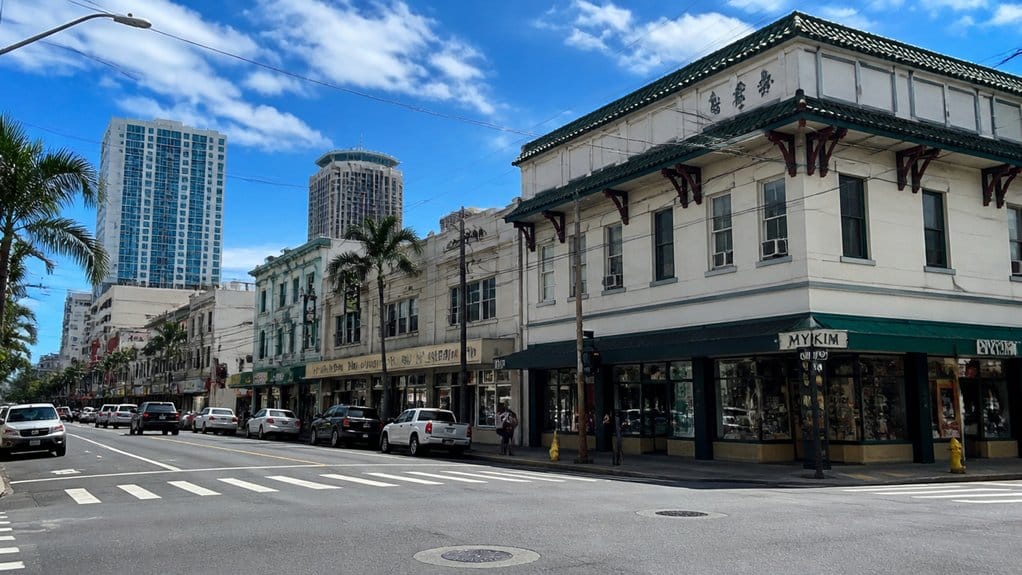
Step just beyond Chinatown and Honolulu keeps unfolding in easy, walkable layers. You’re on the western edge of downtown, so a short stroll opens up more than you’d expect. Head east and you’ll reach Foster Botanical Gardens in about half a mile, where shady paths and giant trees offer a calm break from the market buzz. Keep going and Iolani Palace sits roughly 0.8 miles away.
Closer in, you can browse Oahu Market, Maunakea Marketplace, and Chinatown Cultural Plaza without leaving the neighborhood’s lively orbit. Walk toward Bethel Street and catch the glow of the Honolulu Theatre, still a local favorite. Chinatown also stretches toward Honolulu Harbor, while the Hawaii Capital Historic District begins just east. If you’re staying nearby, Aston at the Executive Centre is an easy walk too. For evening plans, The Other Side Honolulu adds live music bar energy to the area’s after-dark scene.
When Is the Best Time to Visit?
Timing shapes Chinatown Oahu as much as the streets do. You’ll catch its richest energy on weekend mornings, especially Saturday from 8:00 to 12:00, when Oahu Market and Maunakea Marketplace brim with fish, greens, chatter, and steam from food stalls.
- Arrive around 8:00 to 9:00 AM for the freshest produce and the best people-watching.
- Choose weekday lunch if you want busy counters, local diners, and a faster city pulse.
- Skip late afternoon. By 4:00 PM, some blocks can feel oddly hushed, almost like the neighborhood hit snooze.
- Come for First Friday if you want galleries, food trucks, music, and a more festive evening scene.
If you’re planning one ideal visit, daytime wins. You’ll see more open doors, brighter color, and better momentum overall.
For a different mood, late-night drinks at Smith & Kings Chinatown can make the neighborhood feel livelier after dark.
Is Chinatown Oahu Safe to Visit?
While Chinatown Oahu has a rougher reputation than Waikiki, it’s generally safe to visit during the day and feels most comfortable when the markets are humming between 8:00 and 12:00. You’ll see vendors calling out prices, produce stacked high, and steady foot traffic around Oahu Market and Maunakea Marketplace.
After dark, parts of Chinatown can feel much less inviting. Some blocks grow quiet after 5:00, and visitors do report homelessness, graffiti, and occasional bad smells. Most unhoused people won’t bother you, but you should stay alert and use basic city smarts. Stick to main streets like Hotel, Maunakea, and North King. Choose the Chinatown Cultural Plaza garage or metered parking. If you want extra ease, join a walking tour or visit during First Friday when more people are around nearby. For dinner, many visitors pair Chinatown with The Pig and The Lady, one of the neighborhood’s best-known restaurants.
How to Plan a Smart Walking Route
For an easy first pass through Chinatown, start at Maunakea Marketplace at 1120 Maunakea St, where morning food stalls sizzle and lei shops add color before the streets heat up.
- Walk south on Maunakea toward Hotel Street for a compact market-to-temple route.
- Stop early at Oahu Market, ideally 8 to 12, for seafood, odd fruits, and old-school vendors.
- Cross Nuʻuanu Stream to see N King’s paifang gates, then visit Kuan Yin Temple and Izumo Taishakyo Mission Shrine.
- Finish your 1 to 2 hour loop at Chinatown Cultural Plaza and the Wo Fat Building.
Park at the Chinatown Cultural Plaza garage or grab a meter nearby. Go by day, since many shops close after 5pm. If you want stories with your steps, join the Tuesday walking tour. If you are also visiting the Polynesian Cultural Center on the same trip, check its best arrival time so you can avoid longer waits and plan your Oahu day smoothly.
Frequently Asked Questions
What Are Chinatown Oahu’s Typical Business Hours?
You’ll find Chinatown Oahu’s typical hours run mornings through late afternoon: markets peak 8am–12pm, many eateries serve lunch, and most shop schedules follow 9am–5pm. After 5–6pm, street businesses quiet down, though nightlife picks up later.
Are There Guided Food Tours in Chinatown Oahu?
Yes, like opening a treasure chest, you’ll find guided food tours in Chinatown Oahu. You can join Tuesday’s Chinese Chamber walk, explore Culinary history, learn Market etiquette, and pair tastings with nearby Nightlife hotspots afterward.
Which Annual Festivals Take Place in Chinatown Oahu?
You’ll find Chinese New Year celebrations, Lantern Festival events, and Dragon Dance performances annually, plus First Friday art walks, Mid-Autumn festivities, Dr. Sun Yat-sen commemorations, and seasonal Oahu Market festivals that showcase food, culture, and community.
Is Chinatown Oahu Wheelchair Accessible?
Yes, you’ll find Chinatown Oahu partly wheelchair accessible, like traversing a patchwork quilt. You can manage wheelchair traversing on main streets, enjoy some accessible dining, but uneven sidewalks, narrow aisles, and inconsistent curb ramping still require planning.
Where Can You Find Public Restrooms in Chinatown Oahu?
You’ll find restrooms at Chinatown Cultural Plaza, Oahu Market during morning hours, and some larger Maunakea or Hotel Street businesses. Check a public restroom map, ask about portable toilet availability, and confirm restroom sanitizationprotocols before entering.
Conclusion
Now you know exactly where Chinatown Oʻahu sits and how to reach it without guesswork. You can start at the paifang gates, pass fruit stalls on Maunakea, and hear the market clatter near North King Street. Want the smartest plan? Go in the morning for cooler air, easier parking, and brighter produce displays. Stay alert, stick to busy blocks, and wander with purpose. You’ll find history, harbor edges, and lunch all within a few walkable streets.

Pearl Harbor Tribute: Arizona Memorial and Honolulu City Tour
This is an executive class Pearl Harbor Tour, which has been double discounted. We have discounted this tour to the price of a shuttle bus tour.We...
Oahu Ka Moana Lūʻau at Aloha Tower Oceanfront Luau Show
Ka Moana Lūʻau – Oceanfront Hawaiian Luau in HonoluluExperience the spirit of Hawaiʻi at Ka Moana Lūʻau, a...
Pearl Harbor USS Arizona Memorial
Turn back time as we explore WWII history at Pearl Harbor and relive the infamous Sunday morning of December 7, 1941...

Polynesian Cultural Center: Gateway Buffet Package
Located on O‘ahu’s North Shore, the Polynesian Cultural Center is a one-of-a-kind attraction showcasing the peop...
Experiences to explore
 Explore experience ↗
Downtown Honolulu and Chinatown: A Self-Guided Walking Tour
◷ 2 hr–2 hr 30 min
Unlock the storied heart of Hawaii‘s capital, Honolulu on this self-guided walking tour through its Downtown and Chinatown districts. Y
See dates for Current pricing
View dates Explore experience ↗
North Shore Farm: Anahulu River, Kayak-Sup, Turtles, Lunch & More
◷ 5 hr
Witness majestic Honu swimming in their habitat. Explore the scenic Anahulu River's tranquil waters. Meet friendly goats, bunnies, duck
See dates for Current pricing
View dates Explore experience ↗
Private Town Tour with a Local from Honolulu to Diamond Head
◷ 3 hr 30 min
If you're looking for a private tour of the Historic Chinatown’s Maunakea Market Place, up to breathtaking Pali Lookout and around to D
See dates for Current pricing
View dates