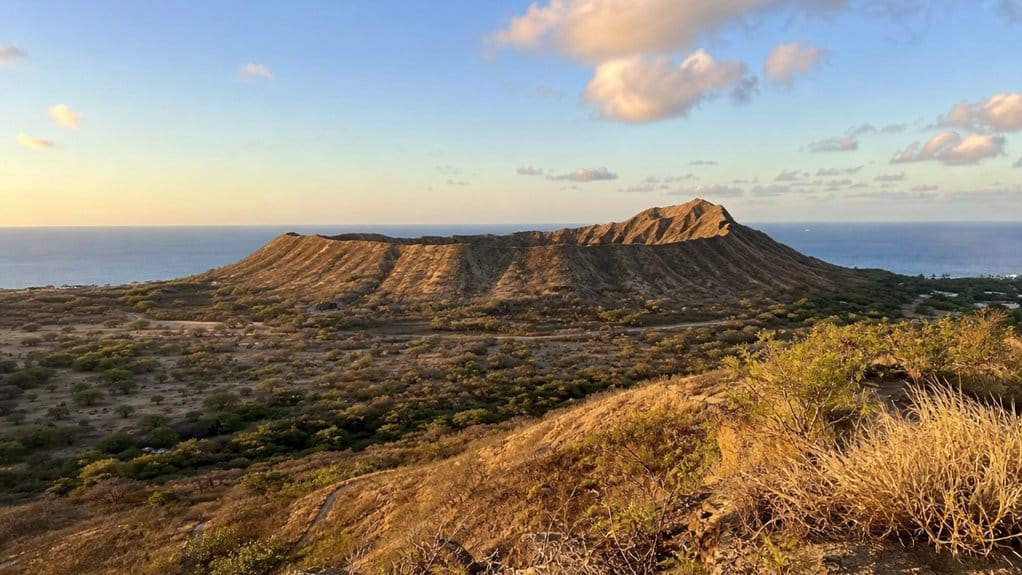
About 300,000 years ago, Diamond Head burst to life in what was likely one brief explosive event, which makes it surprisingly young by Oʻahu standards. When you stand on the crater rim today, you’re looking at layers of gritty tuff built from ash, steam, and shattered rock. Some sources push the date older, even toward 400,000 to 500,000 years. That gap sounds small until you ask why it exists.
Key Takeaways
- Diamond Head most likely erupted about 300,000 years ago during the Pleistocene.
- Some geologic sources estimate its formation closer to 400,000 to 500,000 years ago.
- The volcano formed in one short explosive eruption, probably lasting only days or weeks.
- Diamond Head is a tuff cone created by hydromagmatic explosions, where magma met groundwater.
- No eruption was recorded in human history; it formed long before people settled Hawaiʻi.

Electric Bike Ride & Diamond Head Hike Tour
*During the busy summer months, please check with us for last minute bookings (1 or 2 days before your desired ride date) to ensure Diamond Head hikin...

Diamond Head Hike Shuttle with Reservation Tickets Included
Our Diamond Head Shuttle Tour offers a perfect blend of convenience, adventure, and unforgettable vistas.Stress-Fr...

Diamond Head Hike [Starts at 7:00 a.m.]
---Diamond Hike(Sunrise)--- The Diamond Head hike offers some of the best views of Honolulu, Waikiki, Koko Head and...

Diamond Head Hiking Tour with Tickets and Shuttle Included
The Diamond Head Hike is a 3-hour round-trip adventure, including pick-up and drop-off from your Waikiki hotel. This...
When Did Diamond Head Erupt?
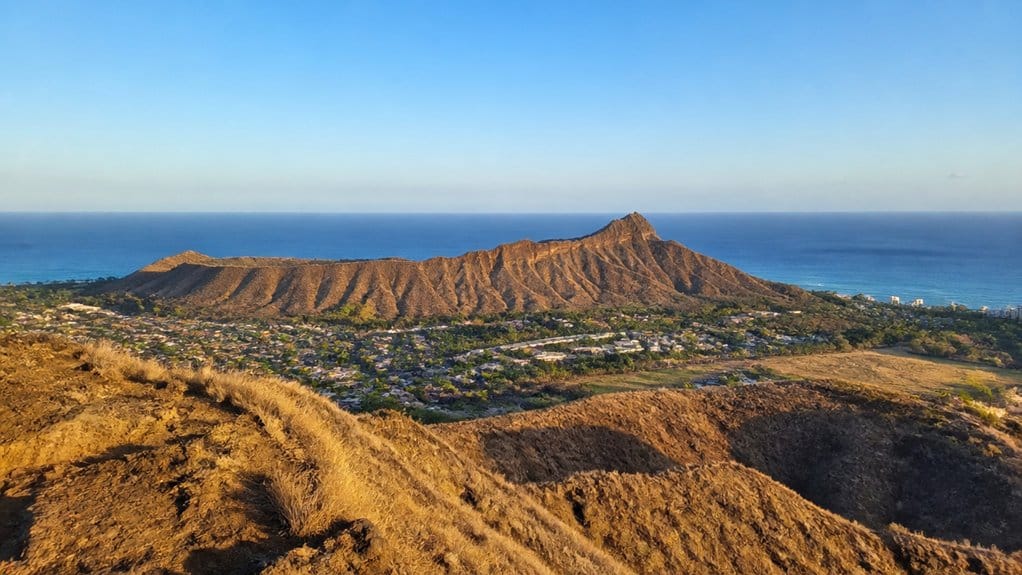
Although Diamond Head looks timeless from Waikiki, it actually burst into being in one short explosive event during the Pleistocene, roughly 300,000 years ago. That means when you gaze up at Diamond Head, you’re seeing the result of a brief volcanic eruption, not ages of repeated blasts. In fact, Diamond Head is a volcano, specifically a tuff cone formed by that explosive event.
Picture a single violent burst punching through coral reef and hard Koʻolau basalt. The explosion threw ash and fine grit into the air, then those particles settled and hardened into the tuff cone you hike today. The crater now spans over 475 acres and includes interior and outer slopes. Visitors planning a crater hike often book a Diamond Head shuttle to reach the trailhead more easily. Some estimates push the date closer to 400,000 or even 500,000 years, but the main idea stays the same. Diamond Head formed fast in one monogenic episode. You can still trace that sudden origin in the crater’s steep walls, dusty trails, and rocky tan slopes today.
How Old Is Diamond Head Crater?
How old is Diamond Head Crater? You’re looking at a young landmark by island standards. Most summaries place Diamond Head around 300,000 years ago, though some estimates put the crater at 400,000 to 500,000 years old. It formed fast, during one explosive event, when magma hit coral reefs and Koʻolau basalt and blasted ash into the air. Geologists describe this as part of Diamond Head’s geological story, tracing a brief but dramatic eruption in the volcano’s history. That single blast created the Diamond Head eruption landform in one short-lived explosive event. It’s also worth remembering that Oʻahu is not the Big Island, a common Hawaii mix-up when discussing famous volcanic landmarks.
| Feature | Diamond Head | Koʻolau Range |
|---|---|---|
| Type | Tuff cone | Shield volcano remnant |
| Age | 300,000 to 500,000 years | 2.6 million years |
| Birth | Brief explosive episode | Much older volcanic building |
| Texture | Ash hardened into tuff | Broad basalt mountains |
| Status | Dormant | Ancient landscape |
As you hike the crater, you’re walking across Pleistocene geology that feels rugged, dusty, and surprisingly recent under your shoes today.
Why Do Sources Give Different Dates?
When you compare dates for Diamond Head, you’ll notice that the numbers can shift because each source may date a different part of the story. One source might give you a broad estimate like 400,000 to 500,000 years, while another trims it to about 300,000 based on what rock or ash it counts. You’ll also run into older quotes and quick online summaries that flatten a brief explosive event into one tidy number, which sounds neat but doesn’t always hold up on the crater rim. Oahu’s wider volcanic history, including the island’s fiery past, helps explain why dating different eruptive features can produce different published ages. Today, there are no active volcanoes on Oahu, which is why current monitoring focuses more on understanding past eruptions than tracking ongoing activity. If you’re planning to explore Oahu’s volcanic landmarks in person, understanding volcanoes on Oahu can help put Diamond Head’s timeline into a broader island context.

Diamond Head Hike [with Lennar's Malasada] [Starts at 7:00 a.m.]
Start your day with a morning hike to Diamond Head! The ticket office is always crowded with people waiting in line...

Waikiki Electric Bike Tour Self Guided: Diamond Head Bike & Hike
Our E-bikes are the most efficient and enjoyable mode of transportation to and around Diamond Head. A more intimate...

Half-Day Hiking Tour to Diamond Head and Makapuu Lighthouse
Experience two of Oahu’s most iconic hikes with Kaimana Tours.This self-guided adventure combines the Diamond H...
Dating Method Differences
Why do sources give Diamond Head different ages? When you compare guidebooks, signs, and geology summaries, you’ll notice they don’t always date the eruption the same way. One source may say about 300,000 years. Another may place it closer to 400,000 or 500,000 years. That’s because researchers may date different parts of the story.
Diamond Head formed in one explosive event through coral reef rock and Koʻolau Volcano basalt. But one study might date the cemented tuff you can see on the crater walls. Another might date mixed debris from the blast that took shape during formation. Some sources also report the crater’s age, while others report volcanic activity in the cone. Same landmark, different target. That’s why the numbers shift, even when the basic origin stays the same for visitors today.
Estimate Range Variations
That difference in what gets dated leads straight to the next source of confusion: the estimates themselves. When you read about Diamond Head, you’ll see dates shift because writers summarize the same story in different ways.
- Some give a range of 400,000 to 500,000 years.
- Others say it formed about 300,000 years ago.
- Some stress that it’s part of the Honolulu Volcanic Series.
- Others focus on one explosive event that built the tuff cone.
You can picture the crater’s dusty slopes and cemented ash, then see why summaries vary. Different studies date slightly different materials within that gritty pile. Popular guides often round numbers for easy reading. Geology-focused sources keep a wider range to show uncertainty. So the mismatch usually reflects presentation, not a totally different Diamond Head story.
Older Source Conflicts
Although the numbers can look messy at first, older sources usually disagree because they’re talking about slightly different clocks. When you read about Diamond Head, one author may mean the cone’s last blast, while another means a broader chapter in Oʻahu’s volcanic story.
That’s why some books say about 300,000 years ago, tied to one brief explosive eruption that built the dusty tuff cone you hike today. Others point to roughly 400,000 to 500,000 years, using different samples, methods, or links to Koʻolau activity. If you’re planning the Diamond Head hike, modern guides also note that reservations now shape how people experience the crater today, even though they don’t affect its geologic age. Visitors also get very different views of the crater and coastline on helicopter tours around Oahu. Those older rocks loom green and folded in the distance, but they’re far older than Diamond Head itself. These features are collectively known to geologists as parts of different volcanic episodes. So you shouldn’t expect one exact birthday, only a solid Pleistocene window.
How Did Diamond Head Form?
Long before hikers climbed its rim for sunrise views, Diamond Head burst into being about 300,000 years ago in a single short eruption that likely lasted only days or weeks, not ages.
You can picture how Diamond Head formed in four quick beats:
- Rising magma hit groundwater near coral reefs and old Koʻolau basalt.
- Steam-charged blasts tore upward, flinging coral and basalt fragments into the air.
- Ash and magma fell back, then fused into tuff as winds spread fine grit around the vent.
- Those layers built a relatively even tuff cone, since the eruption was brief and one-time only.
Diamond Head also features in many half-day hiking tours that pair its crater views with other scenic Oahu stops. Diamond Head sits on Oahu, an island also shaped by the larger Koʻolau Range and the Waianae Range. Today, some visitors pairing geology stops with a Honolulu stay may also notice Hawaii’s new Green Fee tax on accommodations starting in 2026.
Later, weather, erosion, and plenty of Hawaiian sunshine reshaped the crater you see today. What looks calm now began with noise, ash, flying rock, and a very bad day for the reef nearby.
Have a question about this guide?
Ask for tour ideas, hotel suggestions, or a simple trip plan that combines both.
Trip Helper
What Type of Volcano Is Diamond Head?
When you look at Diamond Head, you’re seeing a volcanic tuff cone on Oʻahu, built from ash and fine rock after one sharp explosive eruption. You can trace it to the Honolulu Volcanic Series, a group of smaller craters tied to renewed activity from the old Koʻolau Volcano. That means you’re not standing on a towering lava giant here, but on a compact crater with gritty slopes and a story that likely burned bright for only days or weeks.
Tuff Cone Formation
If Diamond Head looks neat and almost sculpted from a distance, that shape comes from the kind of volcano it is: a tuff cone. You’re seeing tuff cone formation in action, frozen in rock after one powerful blast about 300,000 years ago. If you want the clearest look at those crater walls on foot, the best start window is 6:00 am to 8:00 am.
- Magma hit water as it punched through coral reefs and rock from eruptions from the Koʻolau.
- Those hydromagmatic explosions shattered material into ash, grit, and flying chunks.
- Fine particles settled, then hardened into tuff, the main rock that built the Volcano.
- Bits of coral and Koʻolau basalt got locked inside, giving Diamond Head its rough, mixed texture.
Because it formed in a single eruption, the cone kept a fairly tidy, balanced shape. From the trail, you can almost read the blast in the walls. The full hike has a realistic estimate of about 1.6 miles round trip and often takes 1.5 to 2 hours for many visitors. Before you visit, it helps to check fees and hours so you can plan your hike around current access details.
Honolulu Volcanic Series
That tidy crater shape also tells you where Diamond Head fits in Hawaiʻi’s volcanic story. You’re looking at a cone in the Honolulu Volcanic Series, a later burst tied to renewed action near Koʻolau. Its volcanic identity is a tuff cone, built when magma met water and exploded.
| Feature | What you see |
|---|---|
| Series | Honolulu Volcanic Series |
| Type | Tuff cone |
Those hydromagmatic blasts tore through older coral reefs and Koʻolau basalt, then packed ash and rock into the crater walls you hike today. The name Diamond Head belongs to a volcano that likely formed in one short eruption, not a long chain of episodes. So when you stand on the rim, you’re seeing a brief, dramatic event frozen in stone. It’s dormant now, which is reassuring.
Was Diamond Head Part of Koʻolau Volcano?
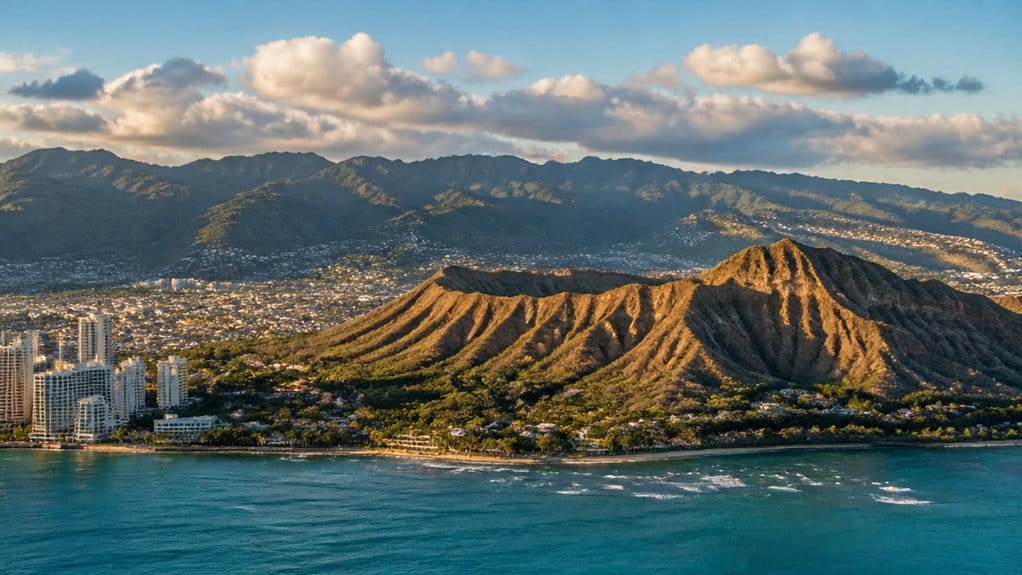
Although Diamond Head sits in Koʻolau’s volcanic family tree, it wasn’t actually built as part of the main Koʻolau shield volcano. When you look closer, you see a cousin, not a direct slice of the old mountain. Diamond Head belongs to the Koʻolau volcano system, yet it formed much later through explosive, associated eruption flows. Today, the Koʻolau Range is especially known for scenic lookouts and sweeping mountain views rather than active volcanic building. Visitors pairing geology with sightseeing often choose a scenic return for extra coastal views and mountain backdrops.
- Koʻolau’s main shield started about 2.6 million years ago.
- Diamond Head appeared only about 400,000 to 500,000 years ago.
- It rose from related vents, but as its own tuff cone.
- It erupted once, making it monogenic, not part of Koʻolau’s long build.
For travelers comparing historic and natural sites on Oʻahu, the Experience Passport is often weighed for whether its bundled Pearl Harbor inclusions are worth the cost.

Diamond Head Bike to Hike and Local Lunch
UPDATE February 2025- Diamond Head is only open half day Monday through Friday due to construction projects, This wi...

Waikiki and Diamond Head Electric Bike Rental
Explore the world renowned Waikiki Beach and Diamond Head crater on one of our luxury e-bikes. Or ride down to the A...

Private Diamond Head and Makapuʻu Hiking Adventure
Experience two of Oʻahu’s most iconic hikes in one unforgettable private adventure!Start with the Diamond Head...
Where Diamond Head Fits in Oʻahu’s Geology
On Oʻahu’s geologic map, Diamond Head sits in the younger Honolulu Volcanic Series, a group of small cones, vents, and lava features that appeared long after the island’s main backbone had formed. That means you’re looking at a much later chapter than Koʻolau’s broad shield-building days. Visitors comparing volcanic landmarks around southeast Oʻahu often pair this history with the Makapuʻu Lighthouse Trail for another scenic look at the island’s coastal landscape.
You can think of this Diamond cone on the Hawaiian island as a younger add-on to an older landscape. It formed when rising magma hit coral reefs and Koʻolau basalt, blasting out ash that settled into tuff and built the crater you see today. In age, it’s young by island standards, about 400,000 to 500,000 years old, while Oʻahu’s main foundation reaches back 2.5 to 4 million years. You can place it beside Koko Head, Punchbowl, and Hanauma Bay. For visitors who prefer easier sightseeing after learning the geology, hotel pickup options can make exploring Oʻahu more comfortable. Because the crater is such a popular destination today, many visitors plan ahead with tickets and reservations before making the hike.
Did Diamond Head Erupt in Human History?
If you’re wondering whether Diamond Head erupted while people were here, the short answer is no. You’re looking at a crater formed roughly 300,000 years ago, long before anyone settled Hawaiʻi or kept records of an eruption. When you hike its dusty trail and scan the coast from the rim, you’re standing on the remains of one brief blast, not a volcano that people watched explode. As with planning a trip to Lanikai Beach, knowing the best time to visit can shape what you expect from the experience.
Predates Human Settlement
While Diamond Head looks dramatic enough to have erupted yesterday, it actually blew its top about 300,000 years ago, with broader estimates often placing it around 400,000 to 500,000 years ago.
When you stand at Diamond Head State Monument, you’re seeing a volcano formed long before people reached Hawaiʻi. On Oahu’s size, Diamond Head stands out as one of the island’s most recognizable younger landmarks. Visitors today often navigate tunnel access and limited parking to reach the crater. This crater formed in one explosive burst.
- Magma hit water and coral.
- Steam blasted out ash and tuff.
- The cone rose as a younger Oʻahu landmark.
- Then erosion took over for ages.
After exploring the crater, many visitors also head toward Tantalus Lookout for another sweeping perspective on Oʻahu.
No Recorded Eruption
Although Diamond Head looks like the kind of crater that might rumble back to life, it didn’t erupt at any point in human history. If you’re wondering about a no recorded eruption, that’s exactly the story here. Diamond Head formed in one brief explosive event about 300,000 to 500,000 years ago, long before any Hawaiian settlement.
When you hike toward Diamond Heads summit, you’re walking across a tuff cone shaped by steam driven blasts, not recent lava. Those blasts likely happened when magma met coral reefs and Koʻolau basalt. Since then, the crater has stayed dormant. You can imagine watchful lookouts, military bunkers, dry rock under your shoes, and trade winds in your ears. Just don’t expect rumbling ground or ash clouds. Its drama belongs to deep time, not recorded history.
Why Diamond Head Looks Like It Does
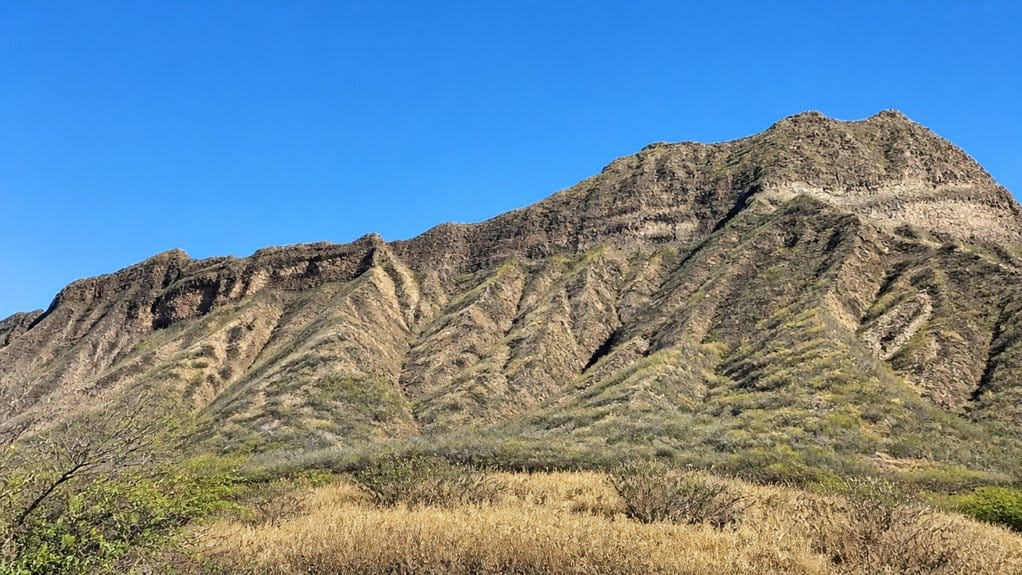
- Water hit rising magma and triggered blasts.
- Those blasts shredded coral, basalt, and ash into gritty layers.
- The loose material settled, then hardened into tough crater walls.
- Wind, rain, and time later trimmed the surface, not the basic form.
That short eruption lasted days to maybe a month, so the cone stayed unusually balanced. You can spot the hard slopes, rough textures, and bowl-like crater from miles away. Even the glinting calcite crystals once fooled people at a quick glance from passing ships. Visitors planning to compare Diamond Head with Pearl Harbor should know bag rules are strict at the USS Arizona Memorial. Today, helicopter tours can make Diamond Head’s balanced cone and crater shape even easier to appreciate from above. Visitors comparing Oahu landmarks often pair this view with a trip to the North Shore to watch the Banzai Pipeline safely from shore.
How Lēʻahi Became Diamond Head
When you hear the name Lēʻahi, you’re hearing how Native Hawaiians saw this crater’s summit, shaped like the brow of a tuna fish fin against the sky. Then British sailors in the 1820s spotted glittering calcite crystals here, guessed they’d found diamonds, and gave the cone its flashy English name with a classic wrong turn. From Waikīkī, many visitors reach the crater by bus or Uber before taking in the views. A popular way to explore the area is on a self-guided route that connects Waikīkī and Diamond Head by electric bike. As you look out over Honolulu and Waikīkī, you can still trace how Lēʻahi became Diamond Head and why both names still cling to the ridge. Today, many visitors pair a hike here with turtle snorkeling in Oahu to experience another side of the island’s natural beauty.
Hawaiian Name Origins
If you trace the crater’s first name, you land on Lēʻahi, the Hawaiian name traditionally read as “the brow of a tuna,” with the summit said to look like an ʻahi’s fin cutting the sky. When you stand below it, that shape feels easy to see.
- You hear Lēʻahi first as a visual name, rooted in form and memory.
- You also meet Hiiaka in one legend, tying the crater to Pele’s family story.
- You notice how Lēʻahi guided local understanding long before Diamond Head appeared on maps.
- You can even glimpse the contrast later visitors brought with calcite crystals and new labels.
That split matters. Lēʻahi speaks to resemblance, place, and wayfinding. Diamond Head belongs to a different reading entirely, one that arrived much later and changed what outsiders called the crater. On Oʻahu, even correct pronunciation carries cultural meaning, much like Hawaiian place names such as Lēʻahi do. As with Manu Hawaiian meaning, the original language often carries layers of identity and interpretation that visitors can easily miss.
British Naming Mistake
Although Lēʻahi already described the crater through its shape, British sailors gave it a very different name in the 19th century after spotting glittering crystals along the beach. If you’d walked that shore, you might’ve noticed those sparkles too, flashing in the sun like tiny gems tossed in the sand.
The sailors guessed they’d found diamonds, and that mistake stuck. In reality, the bright bits were calcite, not anything you’d set in a crown. Still, the new name, Diamond Head, sounded vivid and memorable, so people kept using it in English. You can almost hear the snap judgment behind it: a quick look, a bold label, and a lasting map note. Even after people learned the truth, Diamond Head remained the common name people recognized and still used most often.

Diamond Head Electric Bike Scenic Tour
We start in Waikiki and ride along Kalakaua Ave. (main road in Waikiki) and ride along Kapiolani Park as we ascend t...

Diamond Head Sunrise Hike and Summit Tour with Reservation Ticket
A few things set this tour apart. Every ticket includes a free Green Line trolley return, so you can stay at the sum...

Hawaiian Beauty Package
Experience the best of Oahu’s landscapes in one unforgettable adventure with Kaimana Tours. This combo hike takes...
From Lēʻahi To Diamond Head
At first, the shift from Lēʻahi to Diamond Head seems like a simple name swap, but it actually layers Hawaiian meaning, British guesswork, and volcanic drama into one landmark.
You can trace that change in four quick steps:
- Native Hawaiians called it Lēʻahi, or the brow of a tuna, because the ridge looks like a fin.
- In the 19th century, British sailors spotted calcite crystals and guessed diamonds. Oops, new name.
- Geology tells a wilder story. Diamond Head formed as magma and ash fused into a tuff cone during an explosive Volcanic that took place fast.
- That Head Volcanic origin was monogenic, a single blast, likely around 300,000 years ago, though some estimates stretch to 400,000 to 500,000 years.
Why Diamond Head Was a Military Lookout
Because its summit gives you a clear sweep over the sea and the coast, Diamond Head became one of eastern Oʻahu’s key military lookouts in the early 1900s. You can see why this high crater worked as a strategic military lookout under the Army Coastal defense system. Starting around 1908, crews cut the Kapahulu Tunnel, built a fire control station, and linked the rim by trail.
| Feature | Date | Purpose |
|---|---|---|
| Harlow | 1910 | Coastal fire |
| Dodge | 1913 | Wider coverage |
Around the crater, batteries grew into a 360-degree shield. During World War II, watchers scanned the water for threats after December 7, 1941. Battery 407 added gas-proof tunnels in 1944. No giant guns arrived, but the concrete still whispers duty.
Can You Hike Diamond Head Today?
How do you visit a volcano that once watched for enemy ships? You can hike it today at Diamond Head State Monument, and the route feels accessible yet adventurous. The hiking trail starts near the visitor area on the crater floor and climbs 0.8 mile one way, gaining about 560 feet.
Hike a historic volcano at Diamond Head, where an accessible trail still feels adventurous from crater floor to summit.
- Reserve online before you go.
- Expect a small fee if you don’t live in Hawaiʻi.
- Follow switchbacks, stairs, and tunnels to reach the top.
- Look for old bunker spaces and the 1917 Diamond Head Lighthouse.
The trail is moderately challenging, so you’ll earn the finish. Underfoot, you’ll feel pavement, steps, and worn rock. Around you, trade winds move through dry grass, and voices echo in the tunnel. It’s a short hike, but it doesn’t coast.
What Can You See From the Summit?
Reach the top, and the payoff opens in every direction. From the summit of Diamond Head, you get 360-degree panoramic views that make the climb feel completely worth it. Honolulu spreads out below you, with Waikīkī shining along the shore and the Pacific stretching far beyond the crater rim.
After the 82-step metal staircase, you can scan Oʻahu’s south shore and trace the coastline with your eyes. On clear days, the ocean looks endless, bright, and almost too blue to be real. You can also pick out the 1917 Diamond Head Lighthouse and the nearby bunkers and control-station area. Panoramic views like these are a big reason the hike stays so popular. You’re not just looking around. You’re seeing Hawaii from a high, wide-angle perch, with trade winds as your reward too.

Electric Bike Rentals Waikiki: Honolulu E- Bike Rentals
Explore the world renowned Waikiki Beach and Diamond Head crater on one of our luxury e-bikes. Or ride down to the A...

Downhill Bike and Ko'olau Waterfall Hike Tour
Begin your day with a less than one-mile hike through a privately owned rainforest to a hidden 35ft double-tiered wa...

Half-Day Hiking Experience with Pickup and Mini Acai Bowl and Malasada
Diamond Head Early morning hike and two must-see local gourmet foods in Hawaii! First of all, the first thing in the...
Why Diamond Head Remains Important to Oʻahu
Even though Diamond Head’s eruption happened roughly 300,000 to 500,000 years ago, the crater still shapes life on Oʻahu in ways you can see right away.
- You get why it matters when you spot its rim above Waikiki and the south shore.
- You feel its practical value in the 360-degree views that once guided coastal defense and WWII lookouts after Dec. 7, 1941.
- You see history in old U.S. Army sites, including Battery 407, tucked into the slopes like serious concrete punctuation.
- You experience its future at Diamond Head State Monument, where 475-plus acres protect trails, dry slopes, and a summit hike.
As Diamond Head, a National Natural Landmark, it also anchors conservation, identity, and your sense that Oʻahu’s past still stands watch today.
Frequently Asked Questions
Is Diamond Head Open Every Day of the Year?
Yes, you can usually visit Diamond Head year-round, but you should verify visitor access hours, seasonal closure policies, and holiday scheduling rules first. You’ll often need reservations, and maintenance or special conditions can temporarily affect entry.
How Much Does It Cost to Visit Diamond Head?
You’ll pay a small reservation fee and entry charge if you’re a nonresident; local hiking costs vary by access. Guided tour prices cost more, and transportation expenses depend on whether you drive, rideshare, or join a shuttle.
Are Reservations Required for Diamond Head Entry?
Yes, you’ll need reservations for Diamond Head entry; open views, controlled access. Nonresidents also pay, and permits required support trail safety. Summit trail reservations don’t determine wheelchair accessibility, since the fee-and-entry rules specifically cover hiking access.
Can You Bring Pets Onto the Diamond Head Trail?
You can’t assume pets are allowed on the Diamond Head trail; check current park rules first. If permitted, keep them leashed, follow trail safety tips, avoid wildlife encounters, and consider alternatives if you’re chasing sunrise views.
What Is the Best Time of Day to Visit?
You’ll want early morning, like catching a green light before traffic builds. Sunrise crowds stay lighter, weather conditions feel cooler, and trail safety improves on the exposed stairs; choose late afternoon instead if you’re chasing sunset views.
Conclusion
So when you stand on Diamond Head, you’re looking at the aftereffects of one brief geological outburst about 300,000 years ago, give or take a few ages. That youthful crater still pulls you in with rough tuff walls, windy switchbacks, and wide blue views over Waikiki. You can hike it today with water, good shoes, and a little timing. By the summit, the old lookout story and the sea breeze make Oʻahu feel wonderfully close and grand.

Diamond Head and Manoa Falls Hike and Adventure Tour
Hike up one of Hawaii's most popular craters; Diamond Head. Enjoy amazing views of Waikiki and the South-East-Side of Oahu. Return to your air conditi...
Waikiki Electric Bike Tour Self Guided: Diamond Head Bike & Hike
Our E-bikes are the most efficient and enjoyable mode of transportation to and around Diamond Head. A more intimate...
Diamond Head Hiking Tour with Tickets and Shuttle Included
The Diamond Head Hike is a 3-hour round-trip adventure, including pick-up and drop-off from your Waikiki hotel. This...
Half-Day Hiking Tour to Diamond Head and Makapuu Lighthouse
Experience two of Oahu’s most iconic hikes with Kaimana Tours.This self-guided adventure combines the Diamond H...
Experiences to explore
 Explore experience ↗
Diamond Head Hiking Tour with Ticket and Reservation Inclusion
◷ 3 hr
Start your day by waking up early and hiking up our famous national landmark called Diamond Head. The Diamond Head Crater trail which i
From $50.00 USD
View dates Explore experience ↗
Diamond Head Hiking Tour with Tickets and Shuttle Included
◷ 3 hr
The Diamond Head Hike is a 3-hour round-trip adventure, including pick-up and drop-off from your Waikiki hotel. This 1.6-mile trail alo
See dates for Current pricing
View dates Explore experience ↗
Waikiki Trolley Diamond Head Green Line
◷ 1 hr
Our newest and most unique line takes you to Diamond Head and KCC Farmers’ Market from convenient stops around the Waikiki area. It’s t
See dates for Current pricing
View dates