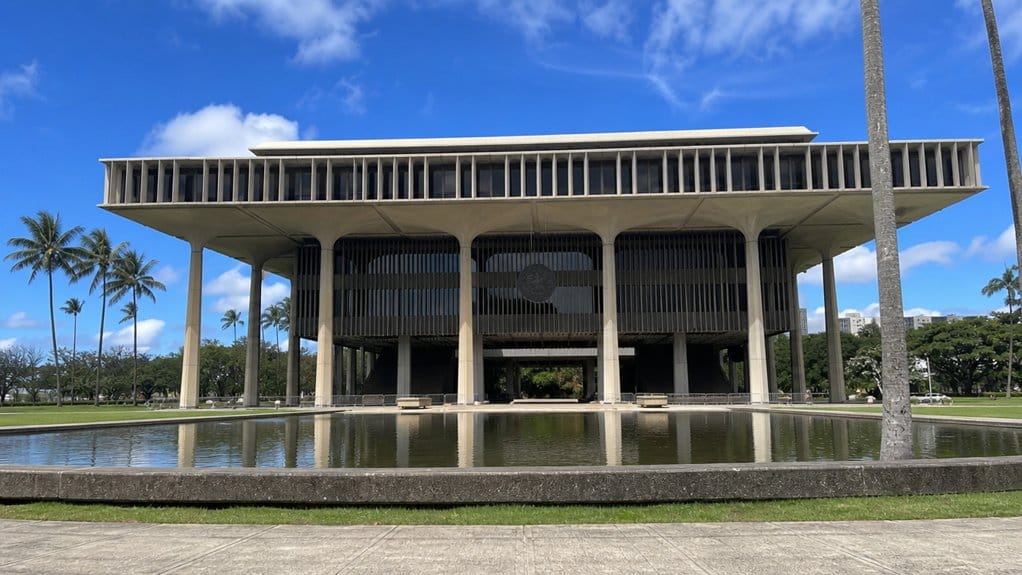
If you expect a domed capitol with sealed halls and heavy stone, Honolulu surprises you fast. You step into an open-air seat of government where a reflecting pool glints in the sun, royal palm columns rise like a formal grove, and the chambers hint at volcano cones. It sits in downtown Honolulu beside some of Hawaii’s most important historic sites. The real intrigue starts when you notice that almost every shape and number means something.
Key Takeaways
- The Honolulu State Capitol is Hawaiʻi’s state government building, housing the Legislature and offices in downtown Honolulu at 415 S. Beretania Street.
- It is known for its open-air atrium, which replaces a traditional dome and symbolizes Hawaiʻi’s connection to sky, wind, and rain.
- The building’s reflecting pool represents the Pacific Ocean, while palm columns, volcano-shaped chambers, and repeated island symbols express Hawaiian identity.
- Visitors can enter on weekdays, use self-guided tour materials, and sometimes need photo ID or masks depending on current access rules.
- The Capitol grounds include important monuments such as the Queen Liliʻuokalani Statue, Liberty Bell replica, Eternal Flame, and Father Damien statue.

Honolulu Scavenger Hunt & Highlights Self-Guided Walking Tour
The Best Way to Discover Honolulu: Scavenger Hunt & Self-Guided Tour. Play, learn, and walk! Explore at your own pace with a 100% self-guided activity...

Charms of Honolulu Private Walking Tour for Couples
Skip the crowds this is a private tour for your group only! Join us on a 2-hour walking tour of Honolulu’s histori...

Self-Guided Walking Audio Tour in Honolulu
Download GuideAlong’s self-guided audio walking tour of Downtown Honolulu and explore the Hawaiian Kingdom’s ric...

Downtown Honolulu Self Guided Walking Audio Tour
Embark on a self-guided walking tour of Honolulu's rich history. Start at Iolani Palace, delve into royal Hawaiian h...
What Is the Honolulu State Capitol?
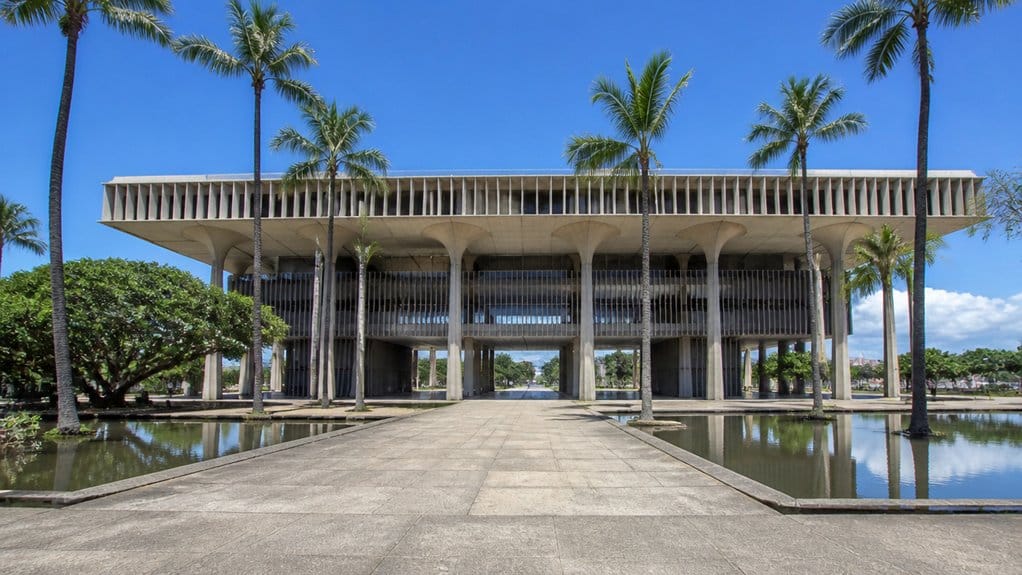
Think of the Honolulu State Capitol as Hawaii’s statehouse with a tropical twist. You’re looking at the Hawai‘i State Capitol, a 1969 landmark in Honolulu that swaps a classic dome for bold symbolic architecture. Belt Lemmon & Lo and John Carl Warnecke shaped it in a modern island style that feels civic and breezy at once.
As you move through the open-air central atrium, trade winds slip past stone and water. A reflecting pool stands for the Pacific. Royal palm columns ring the building, and the volcano-shaped chambers give the House and Senate a striking silhouette. Inside, the Sun and Moon chandeliers glow like oversized jewelry with a purpose. For a closer look at inside the Honolulu State Capitol Building, the interior details reveal how Hawaii’s landscape and government share the same symbolic space. Even the repeated groups of four and eight carry meaning, so you don’t just see government here. You read Hawaii in concrete, light, and air.
Where Is the Honolulu State Capitol?
You’ll find the Hawai‘i State Capitol at 415 S. Beretania Street in downtown Honolulu, right on Capitol Mall. If you’re orienting yourself, look for Iolani Palace nearby. The Honolulu State Capitol sits in a civic pocket that feels both formal and breezy, with open grounds and city traffic humming around it.
For the main entrance, you’ll approach from Miller Street off Punchbowl. If you’re driving, public parking is available in the Capitol basement, plus nearby state options like Lot V Vineyard Garage. You can also use parking by Iolani Palace. The address is easy to plug into your map, and the setting is central enough that you won’t feel lost. Keep the public hours in mind as you plan, especially on weekdays. The coordinates place it squarely in Honolulu’s historic core. A simple 5-step visit plan can help you organize timing, parking, and nearby stops before you go.
Can You Visit the Honolulu State Capitol?
Yes, you can stop in and explore the Hawai‘i State Capitol on weekdays from 7:00 am to 5:00 pm, which makes it an easy add-on to a downtown Honolulu day. Those visitor hours give visitors plenty of time to look around.
You won’t find guided tours now, but you can pick up a self-guided tour brochure from the Governor’s Office of Constituent Services in Room 415. You can also use the virtual tour online. If the Legislature is in session, you can take part through testimony in person, by video, or in writing. Hearings are streamed and archived too. For public access, bring a photo ID just in case. Masks are recommended, and sometimes required. Limited paid parking sits by the Capitol entrance on Miller Street. Wi-Fi and maps help. Before you go, it is helpful to review parking and entry details so you know where to arrive and what to expect.
Why Is the Honolulu State Capitol Unique?
When you first see the Hawaiʻi State Capitol, you notice it doesn’t follow the usual capitol script, because the open-air atrium lets the sky act as its dome and turns the whole building into an island symbol. You can spot the cone-shaped chambers, palm-like columns, and surrounding reflecting pool right away, and each one echoes Hawaiʻi’s volcanoes, islands, and the Pacific. As you walk the grounds, the monuments and clean modern lines show how this 1969 design mixes civic purpose with a strong sense of place. Nearby, Aloha Tower adds another layer of Honolulu history as a landmark tied to Oahu’s harbor.

Pearl Harbor USS Arizona Memorial & Battleship Missouri
Visit USS Arizona and Battleship Missouri, as they represent both the beginning and the end of World War II. The acc...

Oahu's Stunning Views: Half-Day Scenic Tour with 7 Lookouts
Bless your eyes with Oahu's most beautiful wonders. We take you to the MOST IMPRESSIVE SCENEARIES of this island on...

Parasailing Experience in Waikiki, HI
Experience the thrill of Oahu parasailing on this unforgettable 1-hour adventure from Waikiki. Soar up to 1,000 feet...
Open-Air Island Symbolism
At first glance, the Hawaiʻi State Capitol feels unlike any other capitol in the country because it’s open to the sky. As you walk through the open-air atrium, you don’t look up at a dome. You watch sunlight, wind, and even rain move through the space. That simple choice gives the Hawaiʻi State Capitol its natural island symbolism.
Around you, a reflecting pool stands in for the Pacific, adding strong Pacific symbolism. Sometimes you’ll even spot rainbows in atrium mist after a shower. Through glass, the volcanic legislative chambers rise like island cones. Outside, royal palm columns line the edges and represent the eight main islands. Inside, sun and moon chandeliers echo the sky above, tying every detail back to Hawaiʻi. Even the building seems to breathe with the weather. The capitol stands in Honolulu, which is the capital of Hawaiʻi.
Distinctive Architectural Elements
That island symbolism also shows up in the Capitol’s most distinctive architectural elements, which make the whole building feel more like Hawaiʻi than a copy of Washington. At the Hawaiʻi State Capitol, you look up through an open-air atrium instead of a dome, and the sky becomes part of the design. You also notice volcano-shaped chambers rising on either side.
Around the building, royal palm columns stand in careful rows for the eight main islands. A reflecting pool wraps the Capitol like the Pacific, though a brackish well keeps it real and sometimes a little green. Through the glass walls, you can spot Otto Piene chandeliers inside. Their sun and moon symbolism is wonderfully specific: gold globes for the House, white nautilus shells for the Senate. Even the city name carries local meaning, since Honolulu is rooted in the Hawaiian language and is commonly translated as “sheltered harbor.”
Capitol Grounds And Monuments
Step outside the Capitol itself, and the grounds keep telling the story. At the Honolulu State Capitol, you circle a reflecting pool that stands for the Pacific Ocean. It’s fed by brackish well water, and that’s fueled stubborn algae growth since 1969. Even so, the water still gives the site a calm, bright edge.
As you wander, monuments turn the lawn into an open-air history walk. The Queen Liliʻuokalani Statue rises on former royal land. Near Beretania Street, a Liberty Bell replica marks Hawaii’s ties to Washington. You’ll also find the Eternal Flame and the Korean–Vietnam War Memorial, with black marble pedestals and names that stop you short. The Father Damien statue adds another note of service. Altogether, the grounds feel thoughtful, moving, and easy to explore on foot. The setting also reinforces that Honolulu is Hawaii’s capital, placing the state’s government in the heart of the city.
What Do Honolulu State Capitol Symbols Mean?
If you glance around the Hawai‘i State Capitol, you’ll notice that almost every shape means something. You don’t just see a building. You read a story in concrete, water, and light.
- The reflecting pool around the Hawai‘i State Capitol stands for the Pacific Ocean, while the open central atrium frames the legislative chambers as volcano cones.
- The royal palm columns repeat in sets tied to the eight islands, and other patterns point to the four counties. Design here loves a number game.
- Inside, the House glows with a sun chandelier made of gold globes, while the Senate features a moon chandelier made of nautilus shells.
Even the kukui nut trees connect to the four counties and four major Hawaiian gods. Symbols are everywhere, quietly. Before the Capitol era, nearby ʻIolani Palace served as Hawaiʻi’s Capitol for almost 80 years after the 1893 overthrow of the monarchy.
Still comparing Hawai‘i State Capitol, Honolulu?
Ask for tour ideas, hotel suggestions, or a simple trip plan that combines both.
Trip Helper
What Can You See on the Capitol Grounds?
Look around the Capitol grounds and you’ll spot far more than open lawn and government stone. On Capitol Mall, the Queen Liliʻuokalani Statue stands on the historic site once called Haimoeipo. Nearby, the reflecting pool wraps the building like the Pacific, though algae growth sometimes gives the water a stubborn green tint.
At the Beretania Street entrance, you can see the Liberty Bell and the Eternal Flame honoring Hawaii’s service members. You’ll also find the Father Damien Statue and the Korean–Vietnam War Memorial, where black marble pedestals create a solemn rhythm. Four kukui nut trees quietly represent the counties. Around the edges, royal palm columns rise in a ring, echoing the eight main islands. It’s a walk with beauty, memory, and just enough symbolism to keep you looking around. The grounds also sit near ʻIolani Palace, making it easy to pair the Capitol with a visit to one of Honolulu’s most important historic landmarks.
What Happens Inside the Honolulu State Capitol Today?
Step inside and you can catch the Hawaiʻi State Legislature in action, with House and Senate floor sessions often starting in the late morning and committee hearings moving through the day. You can watch testimony happen in person, by video, or in writing, and if you don’t snag a seat, live streams and hearing schedules are easy to find on the Legislature website. As you move through the building, you’ll spot practical touches like free Wi‑Fi, the Public Access Room, and a self-guided tour brochure, which makes civic action feel a little less mysterious and a lot more open. The capitol also sits in Honolulu, the capital city highlighted in many Honolulu facts for its role as Hawaiʻi’s political and cultural center.
Legislative Sessions
While the Hawaiʻi State Capitol may look calm from the outside, its chambers stay busy with the real work of government. When you visit, you’re seeing the House of Representatives and Senate follow a tight session schedule, moving from committee hearings to floor action with clocks, gavels, and rustling papers.
- You can check the live stream through ʻŌlelo Community Media before meetings begin.
- You can use measure tracking to follow bills and see when committee hearings appear online.
- You’ll find visitor access usually runs 7:00 am to 5:00 pm on weekdays, and photo ID may be required.
If you can’t stay long, you can still watch floor sessions online and spot posted times. Public testimony options are listed with notices, and links appear shortly before start time. Some rooms may require masks. Nearby civic and historic visits may also include the Pearl Harbor National Memorial, where free museums and grounds help explain the events of December 7, 1941.
Public Hearings
If you arrive when a public hearing is about to start, the Capitol feels less like a monument and more like a working stage set for democracy. You’ll see each committee room fill with staff, lawmakers, and neighbors clutching notes for public testimony. A Hearing notice tells you the time, room, and entry rules, including building hours and whether you need photo ID.
You can watch House and Senate meetings on ʻŌlelo or catch the live stream online, usually posted shortly before things begin. Some hearings even reach neighbor islands. If you can’t stay, My Legislature lets you submit written testimony, join by videoconference, track bills, and replay archived videos. Start times shift, masks may be requested, and the mood mixes courthouse hush with the rustle of real civic business. Nearby civic services also include the Department of Parks and Recreation at Kapolei Hale, where seasonal events such as Kapolei City Lights may bring the community together.
Frequently Asked Questions
When Was the Honolulu State Capitol Officially Completed?
You can say Honolulu State Capitol was officially completed on March 15, 1969. Despite mentions of 1959 dedication, 1970 inauguration, 1968 construction, 1962 groundbreaking, 1964 topping out, and 1965–1967 phases, you’d cite 1969 completion.
Who Designed the Honolulu State Capitol Building?
Bold yet grounded, you see Belt, Lemon & Lo and John Carl Warnecke designed Honolulu’s Capitol, blending Architectural symbolism, Landscape integration, Modernist influences, Cultural motifs, Seismic engineering, Material selection, Site orientation, Legislative functionality, Public accessibility, Art collaborations.
Is There Parking Available at the Honolulu State Capitol?
Yes, you’ll find limited paid parking in the Capitol basement via Miller Street. Check parking fees, signage, and enforcement. For event parking or capacity issues, use nearby garages, street parking, accessible parking, or park and ride.
Does the Honolulu State Capitol Offer Free Wi‑Fi to Visitors?
Yes, need free wifi? You can use guest access on capitolpublic for visitor connectivity and public internet during network hours. For secure browsing, check device policy, signal strength, hotspot locations, and bandwidth limits in Room 401.
Where Can Visitors Get Maps and Information Inside the Capitol?
You’ll find maps and information at the Visitor Center, Information Desk, and posted Interpretive Panels. Grab Map Brochures for Self‑Guided or Guided Tours, use Interactive Kiosks or the Mobile App, and ask Volunteer Guides about Audio Tours.
Conclusion
When you visit the Honolulu State Capitol, you don’t just see government. You step into a place where water glints, palms rise, and open sky pours through the center like a quiet drumbeat. You can walk the grounds in minutes, then linger by statues, memorials, and the eternal flame. Inside, Hawaii’s daily civic life keeps moving. It’s practical and poetic at once, a building that whispers history while your sandals keep tapping forward.
Honolulu Scavenger Hunt & Highlights Self-Guided Walking Tour
The Best Way to Discover Honolulu: Scavenger Hunt & Self-Guided Tour. Play, learn, and walk! Explore at your own pace with a 100% self-guided activity...
Charms of Honolulu Private Walking Tour for Couples
Skip the crowds this is a private tour for your group only! Join us on a 2-hour walking tour of Honolulu’s histori...
Self-Guided Walking Audio Tour in Honolulu
Download GuideAlong’s self-guided audio walking tour of Downtown Honolulu and explore the Hawaiian Kingdom’s ric...
Downtown Honolulu Self Guided Walking Audio Tour
Embark on a self-guided walking tour of Honolulu's rich history. Start at Iolani Palace, delve into royal Hawaiian h...
Experiences to explore
 Explore experience ↗
Hidden Gems of Oahu Circle Island Tour with Byodo In Temple
◷ 9 hr
Join Go Tours Hawaii as we embark on an Unforgettable Oahu Circle Island tour adventure as we journey through Hawaii's wonders. Availab
From $159.00 USD
View dates Explore experience ↗
Oahu Catamaran Snorkel Tour: See Turtles 100% Guaranteed
◷ 2 hr
Experience one Viator's 2025 Top 20 Best Excursions in the country. This Oahu Catamaran snorkel tour offers unbeatable value and family
From $39.99 USD
View dates Explore experience ↗
Waikīkī to Kahala Beach Open-Air Coastal EV Adventure
◷ 2 hr
Waikīkī's Premier Open-Air Electric Vehicle Tours Best Way to Experience Oʻahu KAHALA COASTAL TOUR Cruise the coastline from Waikīkī to
See dates for Current pricing
View dates